


Never Have So Few Spent So Much

Never Have So Few Spent So Much


Exceptional businesses. Exceptional growth. Changing risk profile.
In the first issue of Dividend and Conquer, “AI Is Getting Into All the Cracks”, I examined how artificial intelligence has spread not only through the economy, but also through the composition of global equity indices with a small group of AI-linked companies now carrying an unusually large share of index returns, earnings expectations and valuations.
Many of those companies are also making some of the largest capital commitments in corporate history - funding much of the infrastructure behind the AI boom.
There is no doubt that growth is coming through. Cloud demand remains strong, AI adoption is rapid and the leading platforms have been tremendous investments. But as expectations and capital commitments rise together it is worth asking whether the balance between opportunity and risk is beginning to shift.

From cash machines to capital-intensive builders
For much of the past decade, the hyperscalers combined rapid growth, high margins and formidable cash generation. Their balance sheets offered investors a margin of safety while their scale reinforced competitive advantages.
AI is changing the financial shape of these businesses. Aggregate investment is accelerating so quickly that capital expenditure is now overtaking free cash flow for the group in aggregate. FactSet expects the five major hyperscalers, Alphabet, Amazon, Meta, Microsoft, and Oracle, to spend more than $750 billion across their respective 2026 financial years, rising to around $1.1 trillion in 2027. As spending rises and free cash flow comes under pressure, external financing is playing an increasingly prominent role in funding the build-out.
This shift matters because it is appearing at a less forgiving point in the interest-rate cycle. As hyperscalers move from funding investment largely through internally generated cash and towards greater use of bonds, leases, project finance and other structures, a higher cost of capital raises the return that new AI capacity must earn merely to create value.

Revenue growth can remain exceptional while shareholder economics become more demanding. Data centres, power infrastructures, networking equipment and advanced chips must be funded before the associated revenue arrives. Depreciation follows later, so the pressure on cash flow can appear before the full cost is visible in reported earnings.
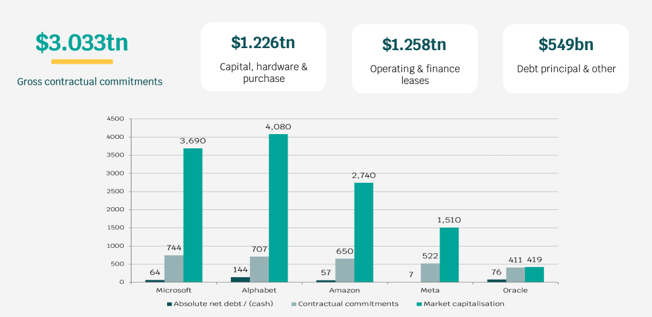
Our internal work suggests that total off-balance-sheet commitments across the major players now run into several trillion dollars. The exact composition differs by company, but the direction is clear: the financial model is becoming more capital intensive and increasingly dependent on future utilisation.
The effect compounds as net cash is spent. Companies forgo interest income on their cash balances while assuming debt or lease obligations at today’s higher financing costs. Long-dated infrastructure is therefore being funded at a materially higher hurdle rate than investors became accustomed to during the era of near-zero yields. Increasingly, the investment case rests not only on the strength of the existing franchise, but on the returns the new infrastructure can generate.
The quality of the promise matters
Remaining performance obligations, or RPOs, are useful evidence of future demand. But they are not cash in the bank. Their value depends on who stands behind the commitment, when the revenue will be recognised and whether the customer can fund it.
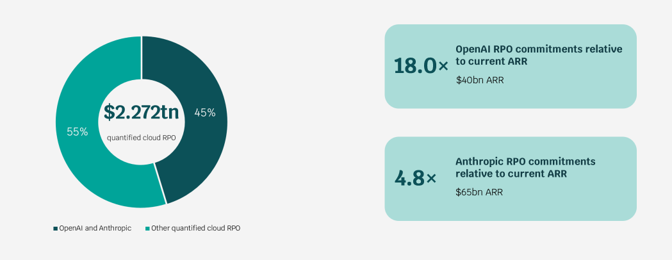
That distinction becomes more important when demand is concentrated among a small number of model developers – predominantly OpenAI and Anthropic. Both are growing rapidly, yet neither is profitable on a US GAAP basis. Their current revenue also remains far below the scale of the infrastructure commitments being built around them. This creates concentration within concentration: index returns depend heavily on hyperscalers, while parts of the hyperscalers’ growth expectations depend on a limited group of AI customers.
Higher yields also matter on the customer side. OpenAI, Anthropic and other model developers must finance operating losses and infrastructure commitments in a more expensive capital market. That does not invalidate their demand, but it increases the importance of funding durability when hyperscalers are committing capital against revenues that may be recognised over many years.
Technology also poses a risk. Smaller and cheaper models are improving quickly, and some companies are showing a willingness to use lower-cost Chinese models where performance is sufficient. If customers can achieve acceptable outcomes with fewer tokens, less compute or lower-cost infrastructure, the volume of investment required to serve each unit of demand may not develop as current forecasts assume.
The bond market is beginning to notice
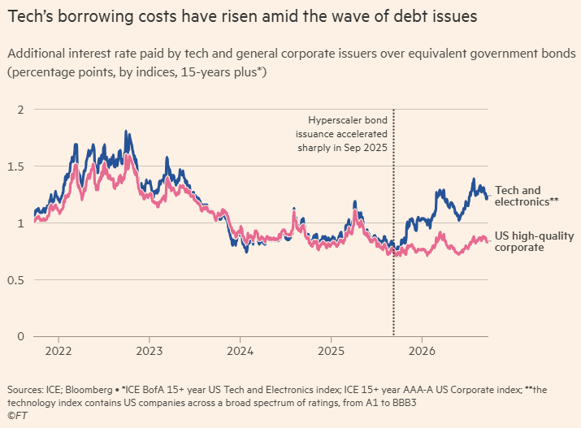
The scale of debt required to finance the AI roll-out is without precedent and is transforming debt markets. Credit markets are not declaring that these companies are distressed. Most remain highly profitable and strategically powerful. But wider spreads indicate that bond investors are demanding more compensation for the changing funding profile. Equity markets, by contrast, continue to place greater weight on revenue growth and AI optionality.
I think that divergence is worth watching. Bond markets focus on claims on cash flow, leverage and refinancing. Equity markets focus on the size and duration of future growth. Both can be right for a time, but they are asking different questions.
Great businesses are not the same as risk-free investments
The hyperscalers remain extraordinary companies. Their distribution, data, engineering talent, customer relationships and financial resources are difficult to replicate. AI is already contributing to growth, and the long-term opportunity may be substantial.
Yet a great business can become a more demanding investment when expectations, capital intensity and customer concentration all rise together. Investors are now being asked to accept:
- Capital expenditure that is absorbing or exceeding free cash flow for parts of the group.
- A rapidly decreasing net-cash buffer and a growing reliance on debt, leases and external financing at higher bond yields.
- RPO growth concentrated among a limited number of unprofitable model developers.
- The possibility that cheaper, smaller and Chinese models reduce the compute required per outcome.
- Valuations that leave less room for delays, weaker utilisation or lower returns on invested capital.
The capital being spent by the hyperscalers is becoming revenue for other companies: semiconductor equipment makers, power-management specialists, data-centre suppliers, cooling providers, electrical infrastructure businesses and software companies that can monetise AI without carrying the full burden of the build-out.
Beyond AI, there are also high-quality companies whose growth depends on very different drivers. In a market where so much capital and attention are concentrated on one theme, diversification may prove useful. Attractive long-term returns do not have to come from the same source.
Balancing participation with resilience
At Dundas, we are not arguing against the hyperscalers or the transformative potential of AI. We are arguing for balance. We want to participate where the cash flows and valuation support the investment case, while remaining alert to the risks created by capital intensity, a higher cost of capital, financing, and concentrated counterparties.
The first issue concluded that AI had found its way into every crack of the index. The next question is clear: when the companies driving that concentration embark on the largest investment cycle in their history, investors must examine not only the growth it creates, but also the cash it consumes and the promises on which it depends.
The hyperscalers may continue to be great businesses. The investment question is whether future returns will compensate shareholders for a risk profile that is no longer what it once was.
Next issue: small things, big impact
“For want of a nail, the kingdom was lost.”
The old proverb is a reminder that economic importance is not always measured by physical size. In the next issue, I will turn from the vast scale of the hyperscalers to a few of the small but critical components on which much larger systems depend. I will highlight companies that Dundas own whose products may represent only a fraction of a customer’s total cost, yet are essential to performance, reliability or safety. That combination of mission-critical value, deep expertise and low-cost relative to the consequences of failure can create powerful business models, durable customer relationships, and attractive long-term dividend growth.
Disclaimer
Dundas Global Investors is the trading name of Dundas Partners LLP. Dundas Partners LLP is authorised and regulated by the Financial Conduct Authority (FCA) in the UK, the Securities and Exchange Commission (SEC) in the USA, and the Australian Securities and Investment Commission (ASIC) in Australia. The Authorised Corporate Director for the Heriot Investment Funds is Waystone Management (UK) Limited which is also authorised and regulated by the Financial Conduct Authority.
Dundas Partners LLP provides investment management services to clients in the UK, USA, Australia, and New Zealand. In this communication Dundas Partners LLP may be referred to as DGI, Dundas or Dundas Global Investors. This document is a financial promotion and intended for professional, eligible counterparty and institutional investors only. The information presented is for the intended recipient(s) and is not to be shared or disseminated without our prior approval. This material has not been prepared for retail clients. Investors are reminded that the price of shares and the income derived from them is not guaranteed and may go down as well as up. Past performance is not a reliable indicator of future results.
This document contains information produced by Dundas and sourced from others where stated. The images used are for illustrative purposes only. The views expressed are those of Dundas and are based on current market conditions. They do not constitute investment advice or a recommendation to buy any security which has been highlighted in this material. Although this communication is based on sources of information that Dundas believes to be reliable, no guarantee is given as to its accuracy or completeness.
In relation to FCA handbook ESG 4.3, Dundas does not market these funds as a ‘sustainability product’. Use of any sustainability related terms in describing the characteristics of the strategy, or inclusion of any third-party information which measures sustainability of our portfolios are for information purposes only.The MSCI® information contained herein: (1) is provided ‘‘as is,’’ (2) is proprietary to MSCI and/or its content providers, (3) may not be used to create any financial instruments or products or any indexes and (4) may not be copied or distributed without MSCI’s express written consent. MSCI disclaims all warranties with respect to the information. Neither MSCI nor its content providers are responsible for any damages or losses arising from any use of this information.
For full information on fund risks and costs and charges, please refer to the Key Investor Information Documents, Annual & Interim Reports, and the Prospectus, which are available on our website (https://www.dundasglobal.com). Recent performance information is also shown on factsheets, available on the website.